Is RAG Dead in 2026? Long Context vs Retrieval, Honestly
AI & ML
By Syed Sartaj Ahmed · 7/21/2026 · 9 min read
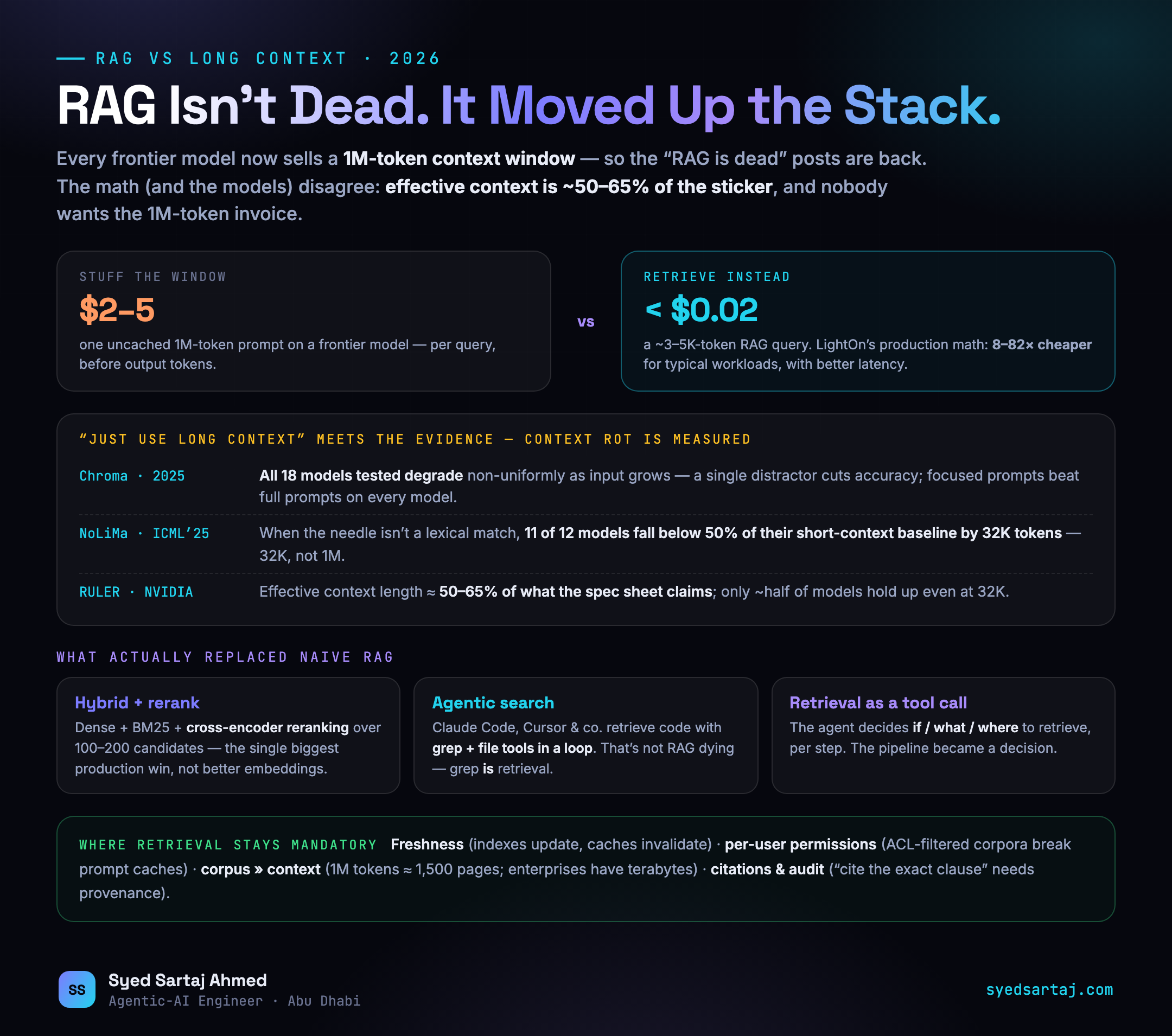
Is RAG dead in 2026? No — but the version most tutorials taught is. Every frontier model now sells a 1M-token context window, so "just stuff everything in the prompt" is back as advice. The problems: an uncached 1M-token prompt costs $2–5 per query (a retrieval-augmented query costs under two cents), and models measurably degrade long before they reach their advertised window. What actually happened is that retrieval moved up the stack — from a fixed embed-and-search pipeline into hybrid search, reranking, and a tool the agent calls when it decides to. I run production RAG; here is the debate with receipts.
The 1M-token era is real — the invoice is too
Claude and the GPT-5.6 family now ship 1M-token windows at standard rates (Anthropic dropped the long-context surcharge; Gemini still bills more above 200K). But capacity isn't economics: one uncached 1M-token call on a frontier model runs $2–5 before output tokens, while a typical 3–5K-token RAG query costs well under $0.02. LightOn's production analysis puts retrieval at 8–82× cheaper than long context for typical workloads, with better latency. (You'll see "1,250× cheaper" circulating — that's un-audited blog math; use the defensible range.)
Context rot: the degradation is measured, not vibes
- Chroma's context-rot study (18 models including Claude 4, GPT-4.1/o3, Gemini 2.5): every model degrades non-uniformly as input grows, a single distractor cuts accuracy, and focused prompts beat full prompts on all 18.
- NoLiMa (ICML 2025): when the "needle" doesn't lexically match the question, 11 of 12 models fall below 50% of their short-context baseline by 32K tokens. Thirty-two thousand — not a million.
- RULER (NVIDIA): effective context length is roughly 50–65% of the marketed number; only about half of models hold up even at 32K.
- Anthropic's own engineering guidance says it plainly: as context grows, recall accuracy falls — models have a finite "attention budget."
Near-perfect needle-in-a-haystack demos don't contradict this: NIAH tests lexical recall, the easiest case. Real questions are non-lexical, and that's exactly where long context breaks first.
Doesn't prompt caching fix the economics?
Partially — and only for static, shared corpora. Cached reads are ~90% off, which still leaves a cached 1M-token query carrying 30–80× the token volume of a retrieval query. Worse, caches break exactly where enterprises live: the corpus updates, or each user is only allowed to see their own document subset (ACLs), which makes every user a cache miss. Per-user permissions are the quiet RAG-keeper nobody's hot take mentions.
What actually replaced naive RAG
- Hybrid retrieval + reranking. Dense vectors + BM25, then a cross-encoder reranker over 100–200 candidates. In production this reranking step — not a better embedding model — is the single biggest quality win.
- Agentic search. Claude Code, Cursor and the other coding agents retrieve with grep and file tools in a loop rather than a vector index. That gets cited as "RAG is dead" — but grep is retrieval. (And the "Claude Code ripped out its RAG pipeline" story is folklore: Anthropic evaluated embeddings-based retrieval in prototypes and chose just-in-time agentic search; production Claude Code never shipped a vector DB.) Code is also the friendly case for lexical search — identifiers are literal strings. Non-lexical, semantic and multimodal queries are precisely where NoLiMa shows grep-style matching fails.
- Retrieval as a tool call. The agent decides if, what and where to retrieve at each step — query reformulation, source selection, compaction. As one Forbes piece put it this month: RAG didn't die, it moved up the stack.
The adoption data agrees
Menlo Ventures' enterprise survey (Dec 2025) has RAG as the #2 customization technique after prompt design — fine-tuning is niche. VentureBeat's Q1 2026 pulse shows hybrid-retrieval adoption intent tripling in a quarter (10.3% → 33.3%) while dedicated vector-DB vendors lose share to custom retrieval stacks (35.6%). That's not abandonment — it's a rebuild: teams are keeping retrieval and dropping the one-size pipeline.
Where retrieval stays mandatory
Freshness (your data changes; indexes update, caches invalidate). Permissions (per-user ACL filtering breaks both long context and its cache). Corpus » context (1M tokens is ~1,500 pages; enterprises have terabytes). Citations and audit ("cite the exact clause" needs retrieval provenance, not a model's memory of a megaprompt).
FAQ
Is RAG dead in 2026?
No. Naive embed-chunk-retrieve pipelines are being replaced, but retrieval itself is growing — as hybrid search, reranking and agentic retrieval inside agent loops.
Does a 1M-token context window replace RAG?
Only for small, static, shared corpora where cost doesn't matter. Effective context is ~50–65% of the sticker, degradation starts by 32K on non-lexical tasks, and the cost gap is 8–82×.
What is agentic RAG (or agentic search)?
Retrieval as a decision inside the agent loop: the model chooses when to search, reformulates queries, picks sources (vector index, BM25, grep, SQL, web), and iterates on what comes back.
Is grep replacing embeddings?
For code, often yes — identifiers are lexical. For semantic questions over prose, no: that's the exact failure mode the NoLiMa benchmark measures.
Building or fixing a retrieval stack? Get in touch — this is my day job. Related: my RAG stack for 2026, do you need a vector database? and how I built a production RAG assistant.
Tags: RAG, Long Context, Retrieval, Agentic AI, LLM