RAG Tech Stack 2026: The AI Engineer's Cheat Sheet (Vector DBs, Frameworks, Eval)
AI & ML
By Syed Sartaj Ahmed · 7/3/2026 · 8 min read
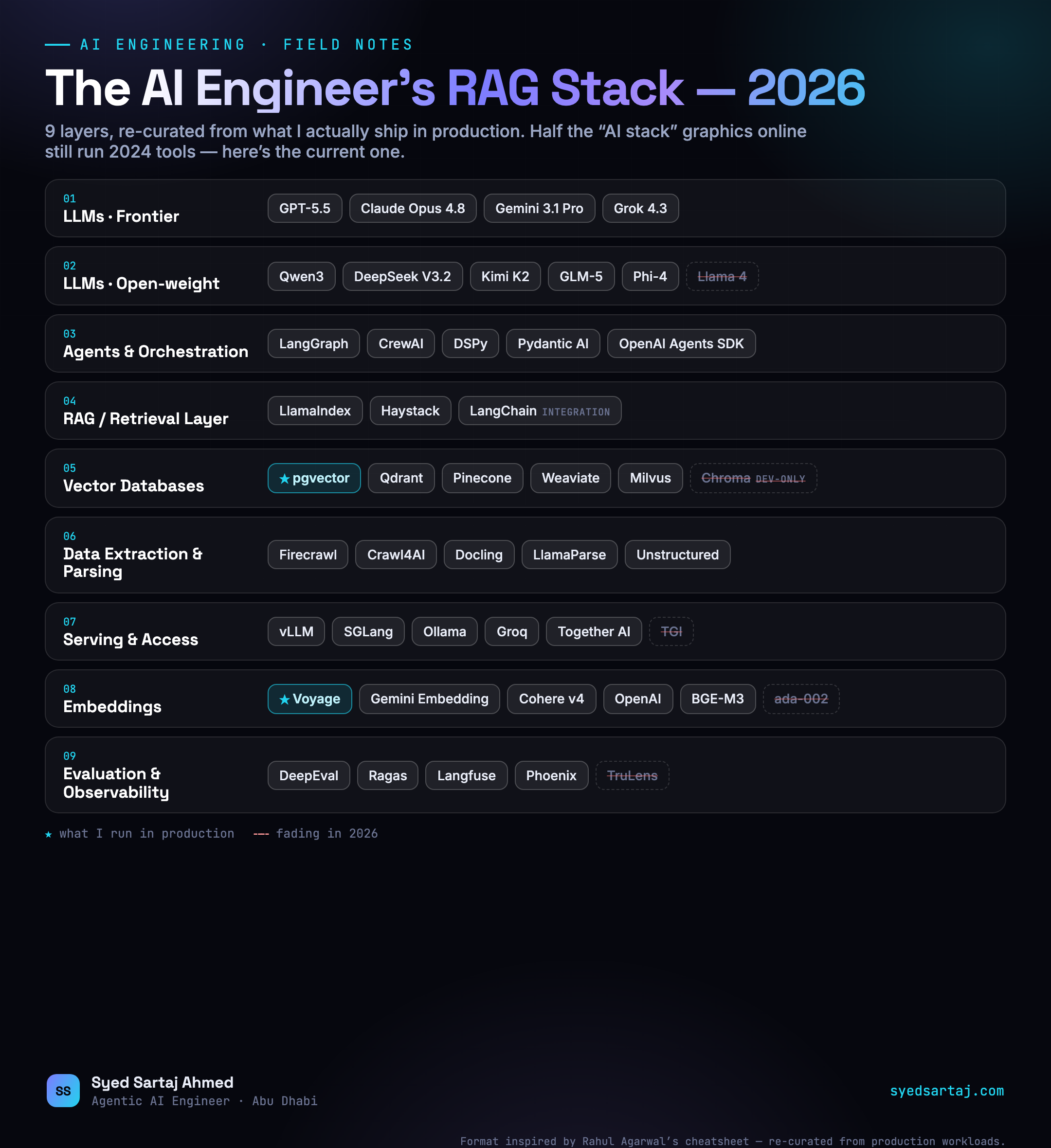
Half the “AI engineer stack” graphics on your feed are running 2024 tools. The open-weight king isn’t Llama anymore, bare LangChain isn’t the agent default, and Hugging Face TGI is in maintenance mode. So I rebuilt the stack for how I actually ship production RAG in 2026 — nine layers, curated, with the fading tools flagged.
1. LLMs — frontier and open-weight
Frontier (closed API) is a four-horse race: GPT-5.5 (best all-rounder), Claude Opus 4.8 (best coding and prose), Gemini 3.1 Pro (reasoning and price/performance), and Grok 4.3. The bigger 2026 story is open-weight: Qwen3 is the Apache-2.0 default you run locally, DeepSeek V3.2/R1 and Kimi K2 (a genuinely strong agentic coder) lead, with GLM-5 and Phi-4 filling niches. Meta’s Llama 4 has slipped behind this pack — it’s no longer the reflexive open pick.
2. Agent frameworks & orchestration
LangGraph is the production default now — stateful, durable execution used by teams like Uber, LinkedIn and Klarna. Bare LangChain is still a fine integration layer, but it’s not where you build cutting-edge agents. Around it: CrewAI for fast multi-agent, DSPy for prompt-as-compilation, the rising type-safe Pydantic AI, and the OpenAI Agents SDK.
3. The retrieval layer
For the RAG data path itself: LlamaIndex has the best ingestion and retrieval primitives, Haystack shines for regulated/high-stakes pipelines, and LangChain’s retrievers round it out.
4. Vector databases
My daily driver is pgvector — if your data already lives in Postgres, co-locating vectors there (add pgvectorscale past a few million rows) is the boring, correct default; one database, one backup story. Beyond that: Qdrant is the open-source latency leader, Pinecone for managed enterprise scale, Weaviate for native hybrid search, Milvus at billion-scale. Chroma is great for local prototyping but isn’t an enterprise-scale peer — don’t ship it as one.
5. Data extraction & parsing
Garbage in, garbage retrieved. For the web: Firecrawl (crawl + parse to clean markdown/JSON) and Crawl4AI. For documents: Docling (IBM’s open-source breakout), LlamaParse (agentic OCR), and Unstructured. Naive PDF-to-text and bare Tesseract are superseded by layout-aware parsing — your chunk quality depends on it.
6. Serving & model access
Self-hosting: vLLM is the production default (PagedAttention, OpenAI-compatible), with SGLang rising fast on prefix-heavy workloads and Ollama for local dev. Hosted access: Groq for the fastest tokens, Together AI for breadth of open models. Note Hugging Face TGI is now in maintenance mode — HF themselves point you to vLLM/SGLang.
7. Embeddings
The other model choice that decides your retrieval quality. I use Voyage (retrieval-specialized) in production; strong alternatives are Gemini Embedding (top of MTEB), Cohere embed-v4 (multimodal), OpenAI’s text-embedding-3-large, and open-weight BGE-M3. OpenAI’s ada-002 and generic MiniLM are legacy now — don’t start a new project on them.
8. Evaluation & observability
The layer most teams skip and later regret. For CI/CD gating: DeepEval (“Pytest for LLMs”) and Ragas (RAG-specific metrics + synthetic test generation). For tracing in production: Langfuse (open-source, hot right now) and Arize Phoenix (OpenTelemetry-native). Treat retrieval quality as a metric you alert on, not a vibe.
How I actually assemble it
My production RAG assistant is deliberately boring: Docling/Firecrawl for ingestion, Voyage embeddings, pgvector on the same Postgres as the app, retrieval wired through a LangGraph flow, and Ragas gating changes in CI. No exotic infrastructure — the wins come from getting the boring parts right and measuring them.
The rule that outlasts any tool list
Tools churn every quarter; the architecture doesn’t. Keep each layer swappable behind a clean interface, measure retrieval quality relentlessly, and don’t adopt a tool because it trended — adopt it because it moved a number you track.
I build agentic AI and RAG systems in production. If you’re working on LLM infrastructure or hiring engineers who obsess over this stack, let’s talk.
Format inspired by Rahul Agarwal’s AI-stack cheatsheet — every layer here re-curated from my own production workloads.
Tags: RAG, AI engineering, LLM, Vector database, LangGraph, pgvector, Embeddings, MLOps