The 6 Types of AI Models in 2026: LLM, SLM, LRM, VLM, LCM & LAM
AI & ML
By Syed Sartaj Ahmed · 7/9/2026 · 7 min read
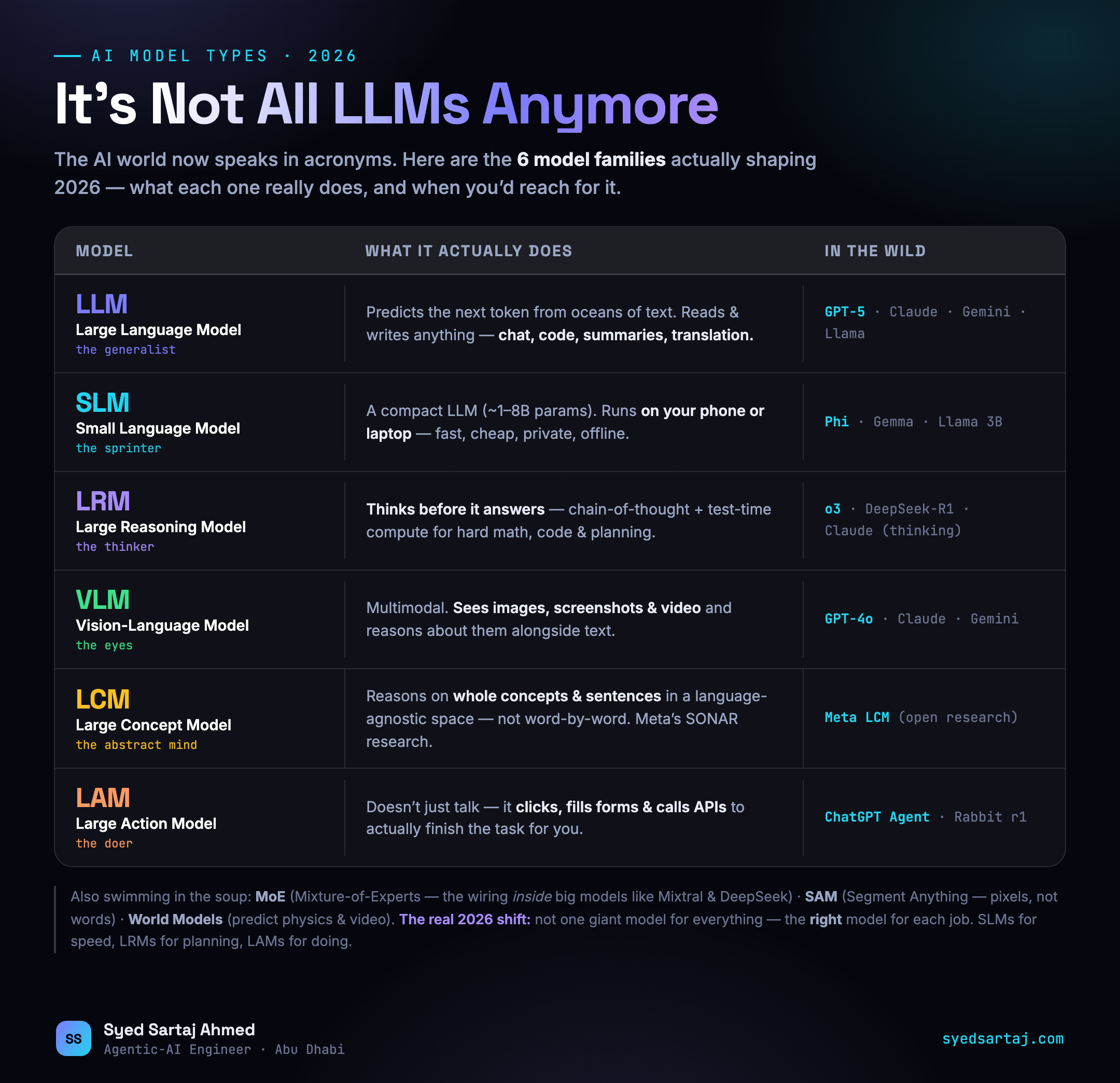
What are the different types of AI models? In 2026, "AI model" no longer just means a chatbot. The field has split into distinct families, each tuned for a different job: LLMs for text, SLMs for on-device speed, LRMs for deep reasoning, VLMs for vision, LCMs for concept-level reasoning, and LAMs for taking action. If the acronyms are starting to blur together, here is the plain-English version — what each one does, and when you would actually reach for it.
LLM — Large Language Model (the generalist)
The model that started the boom. An LLM is trained on a huge slice of the internet to predict the next token, and from that single objective it picks up language, logic, and a surprising amount of world knowledge. It reads and writes anything text-shaped — chat, code, summaries, translation. Think GPT-5, Claude, Gemini, and Llama. When people say "AI" today they usually mean an LLM — but it is only one family out of six.
SLM — Small Language Model (the sprinter)
An SLM is a compact LLM, typically 1–8 billion parameters, small enough to run on a laptop or even a phone. It trades a little breadth for big wins in speed, cost, privacy, and offline use — no data has to leave the device. Models like Microsoft's Phi and Google's Gemma are often distilled from larger models, and in 2026 they quietly power a lot of on-device and high-volume work where routing every request to a giant cloud model would be slow and expensive.
LRM — Large Reasoning Model (the thinker)
An LRM is built to think before it answers. Instead of replying instantly, it spends extra compute at inference time working through a problem step by step (chain-of-thought), which sharply improves hard math, coding, and multi-step planning. OpenAI's o3, DeepSeek-R1, and Claude's extended-thinking mode are the headline examples. The trade-off is latency and cost — you reach for an LRM when getting it right matters more than getting it fast.
VLM — Vision-Language Model (the eyes)
A VLM is multimodal: it understands images, screenshots, charts, and video alongside text, and reasons across both. Show it a UI mockup and it writes the code; show it a receipt and it extracts the totals. GPT-4o, Claude, and Gemini all have strong vision. This is the family that lets AI operate on the visual world instead of only on words.
LCM — Large Concept Model (the abstract mind)
This one is more research than product, but it hints at where the field may go next. Meta's Large Concept Model does not predict the next word — it reasons over whole concepts (roughly, sentences) in a language- and modality-agnostic embedding space called SONAR. Because the reasoning happens above any single language, the same output can be decoded into 200+ languages or into speech without being regenerated. It is an attempt to make models think a little more like humans do — in ideas, not tokens.
LAM — Large Action Model (the doer)
An LLM can describe how to book a flight. A LAM actually books it. Large Action Models are trained to plan and execute sequences of actions — clicking buttons, filling forms, calling APIs, navigating software — to complete a task end to end. OpenAI's ChatGPT Agent (launched 2025) and the Rabbit r1 are early examples. This is the family underneath the "AI agents" everyone is talking about: the shift from generating content to getting things done.
The rest of the alphabet soup
A few more terms you will bump into:
- MoE (Mixture-of-Experts) — not a model type but an architecture. The model is split into many "expert" sub-networks and each token is routed to only a few, so you get the capacity of a huge model at a fraction of the compute. Mixtral and DeepSeek are built this way.
- SAM (Segment Anything Model) — a vision model that isolates any object in an image at the pixel level. No words involved; it is about where things are, not what to say.
- World Models — models that learn a predictive simulation of an environment (physics, video, game state), used in robotics and video generation.
So which model do you actually use?
The real story of 2026 is not one model winning. It is the end of "one model for everything." Production systems increasingly stack them: an LRM plans, a LAM executes, a VLM reads the screen, and cheap SLMs handle the high-volume, latency-sensitive glue in between. The skill is no longer picking the single "best" AI — it is routing each job to the right family. Bigger is not the goal anymore; fit is.
FAQ
What is the difference between an LLM and a LAM?
An LLM generates text — it can tell you the steps to complete a task. A LAM (Large Action Model) actually performs the task: it clicks, fills forms, and calls APIs to get it done. LAMs usually build on top of an LLM's language understanding.
What is a Large Concept Model (LCM)?
An LCM, introduced by Meta, reasons over whole concepts or sentences in a language-agnostic embedding space (SONAR) instead of predicting one token at a time. The same reasoning can be decoded into many languages or into speech without being regenerated.
What is the difference between an LLM and an SLM?
An SLM (Small Language Model) is a compact version — usually 1–8B parameters — built to run cheaply and privately on-device, while an LLM is a much larger cloud model with broader capability. SLMs trade some breadth for speed, cost, and offline use.
Are reasoning models (LRMs) just LLMs?
They are a specialised branch. An LRM is an LLM tuned to spend extra compute "thinking" step by step at inference time, which improves hard reasoning, math, and planning at the cost of speed.
Building with these models?
I build agentic-AI and full-stack systems in Abu Dhabi — production RAG, multi-agent automation, and LLM features that are actually reviewed and tested, not just generated. If you are figuring out which model fits your product, let's talk.
Tags: AI Models, LLM, Large Action Model, Agentic AI, Machine Learning