How Developers Actually Use AI in 2026 (vs Everyone Else)
AI & ML
By Syed Sartaj Ahmed · 7/4/2026 · 6 min read
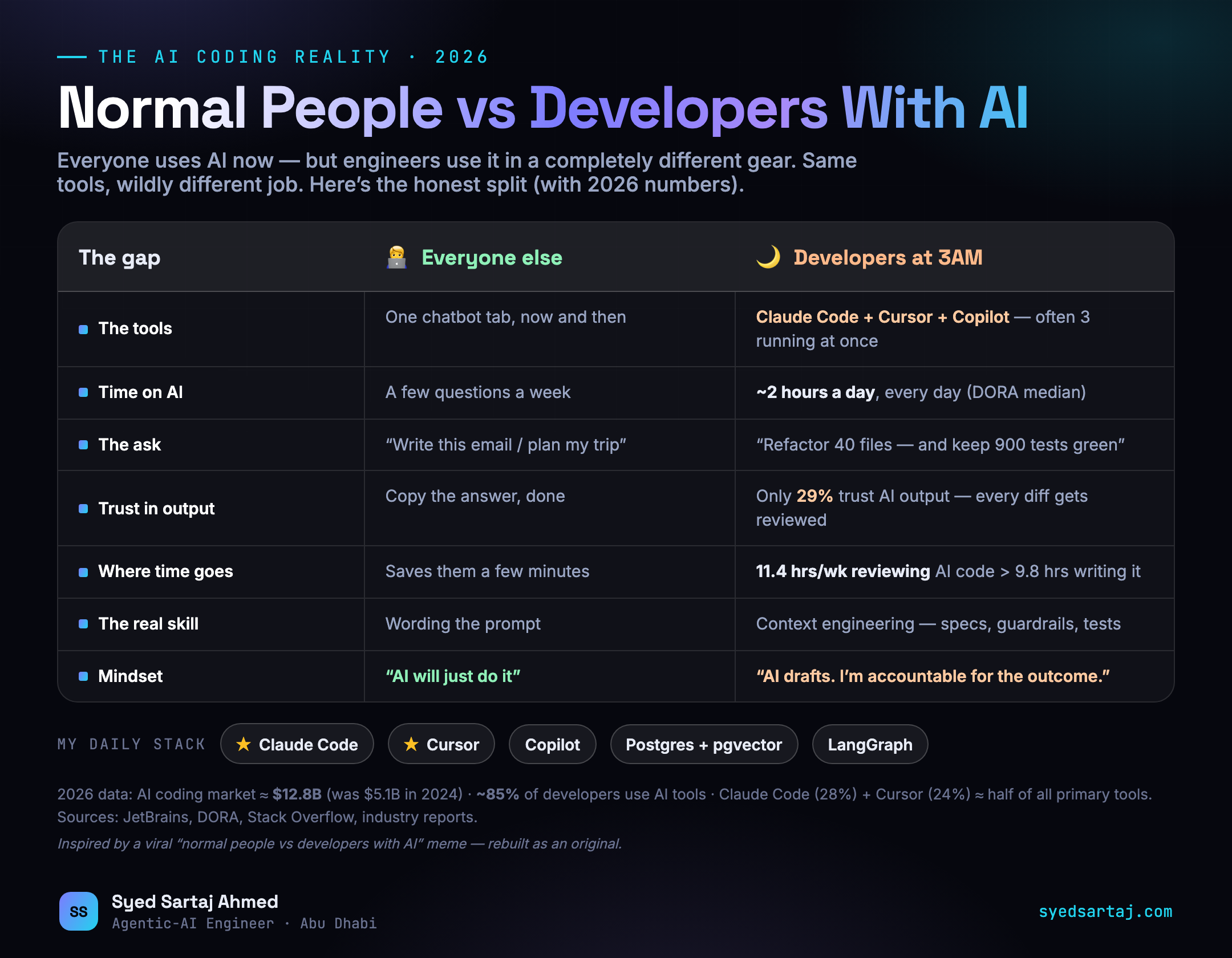
Everyone uses AI now — but developers use it in a completely different gear. For most people, AI is an occasional chatbot tab: write an email, plan a trip, summarise an article. For engineers, it is an all-day power tool. We run Claude Code, Cursor and GitHub Copilot — often three at once — for hours every day, and we trust almost none of it blindly. The result is a workflow that looks nothing like casual AI use: less typing, far more reviewing, and a new core skill called context engineering. Here is the honest split, with real 2026 numbers.
There is a meme going around — "normal people with AI" up top, "developers with AI at 3AM" grinding in a field down below. It is funny because it is true. Let me unpack why the gap is that wide.
One chatbot tab vs three agents at once
A casual user opens a single assistant now and then. A working engineer runs a fleet. In 2026, Claude Code (~28%) and Cursor (~24%) together account for roughly half of all "primary tool" choices among professional developers, and most of us combine them: Cursor for fast in-editor changes, Claude Code for the heavy, multi-file, agentic tasks that touch dozens of files at once.
This is not a niche habit. The AI coding tools market roughly doubled to about $12.8B in 2026 (up from $5.1B in 2024), around 85% of developers now use AI tools, and DORA data puts the median engineer at about two hours a day of AI-assisted work. AI is no longer a novelty in the toolbox — for a lot of us it is the toolbox.
The numbers nobody puts on the meme
Here is where developer AI use diverges hard from everyone else's. Casual users tend to copy the answer and move on. Engineers do the opposite — they distrust by default:
- Only ~29% of developers trust AI output to be accurate in 2026, down from 40% in 2024. Familiarity bred caution, not blind faith.
- Developers now spend roughly 11.4 hours a week reviewing AI-generated code versus about 9.8 hours writing new code — a reversal of the old pattern.
Read those two together and the meme writes itself. The job did not disappear; it moved. We type less and review more. The AI is a fast, confident junior that occasionally hands you subtly wrong code with a straight face — so every diff gets read before it ships.
The skill changed from "prompting" to context engineering
In 2023 the meme skill was prompt wording. In 2026 that is table stakes. The real leverage is context engineering: feeding the agent the right specs, constraints, tests, and your codebase's actual conventions so it produces output you can trust and review quickly. Spec-driven workflows — where you write the feature spec and guardrails first, and the agent implements against them — consistently beat free-form "vibe coding" on anything non-trivial.
Put differently: casual AI use optimises a single answer. Engineering with AI optimises a system — goals, constraints, and quality checks that a set of agents operate inside, with a human accountable for intent and outcome.
So why are we up at 3AM?
Because the grind moved, it did not vanish. The agent drafts a feature in minutes; then you own the hard 20% — reviewing every change, keeping 900 tests green, and debugging the one thing the model got quietly wrong. That is the "harvesting in the field at 3AM" punchline in a nutshell: it is the 11.4-hours-of-review stat, lived out one late night at a time. The speed is real. So is the accountability that comes with it.
What this actually means for you
- If you are learning to code: practise reading and reviewing code, writing tests, and structuring context — not just prompting. The reviewer skillset is now the job.
- If you are hiring engineers: judgment, system design, and verification matter more than raw typing speed. Anyone can generate code; few can tell when it is wrong.
- If you are a "normal" AI user: you are getting enormous value from the easy 80% — and that is genuinely great. Developers just live in the hard 20%, which is why our version looks like farming at midnight.
FAQ
Which AI coding tools do developers use most in 2026?
Claude Code (~28%) and Cursor (~24%) lead as primary tools, and GitHub Copilot has the widest overall distribution and the best free tier. Most professional engineers combine two or three rather than picking one.
Do developers actually trust AI-generated code?
Mostly no. Only about 29% of developers trust AI output as accurate in 2026, so nearly every AI-written change is reviewed and tested before it reaches production.
Is AI replacing developers?
It is replacing typing, not judgment. Time has shifted from writing code to reviewing it and engineering context. The accountability for correctness still sits with a human.
What is context engineering?
Giving the AI the right specs, constraints, tests, and codebase conventions so it produces correct, reviewable output. It is the 2026 successor to "prompt engineering."
Building with AI agents?
I build agentic-AI and full-stack systems in Abu Dhabi — production RAG, multi-file automation, and LLM features that are actually reviewed and tested, not just generated. If you are shipping something in this space and want a second pair of hands, let's talk.
Tags: AI Coding, Agentic AI, Developer Tools, Claude Code, Software Engineering