Claude vs GLM (2026): Coding Benchmarks, Price & When to Use Each
AI & ML
By Syed Sartaj Ahmed · 7/6/2026 · 7 min read
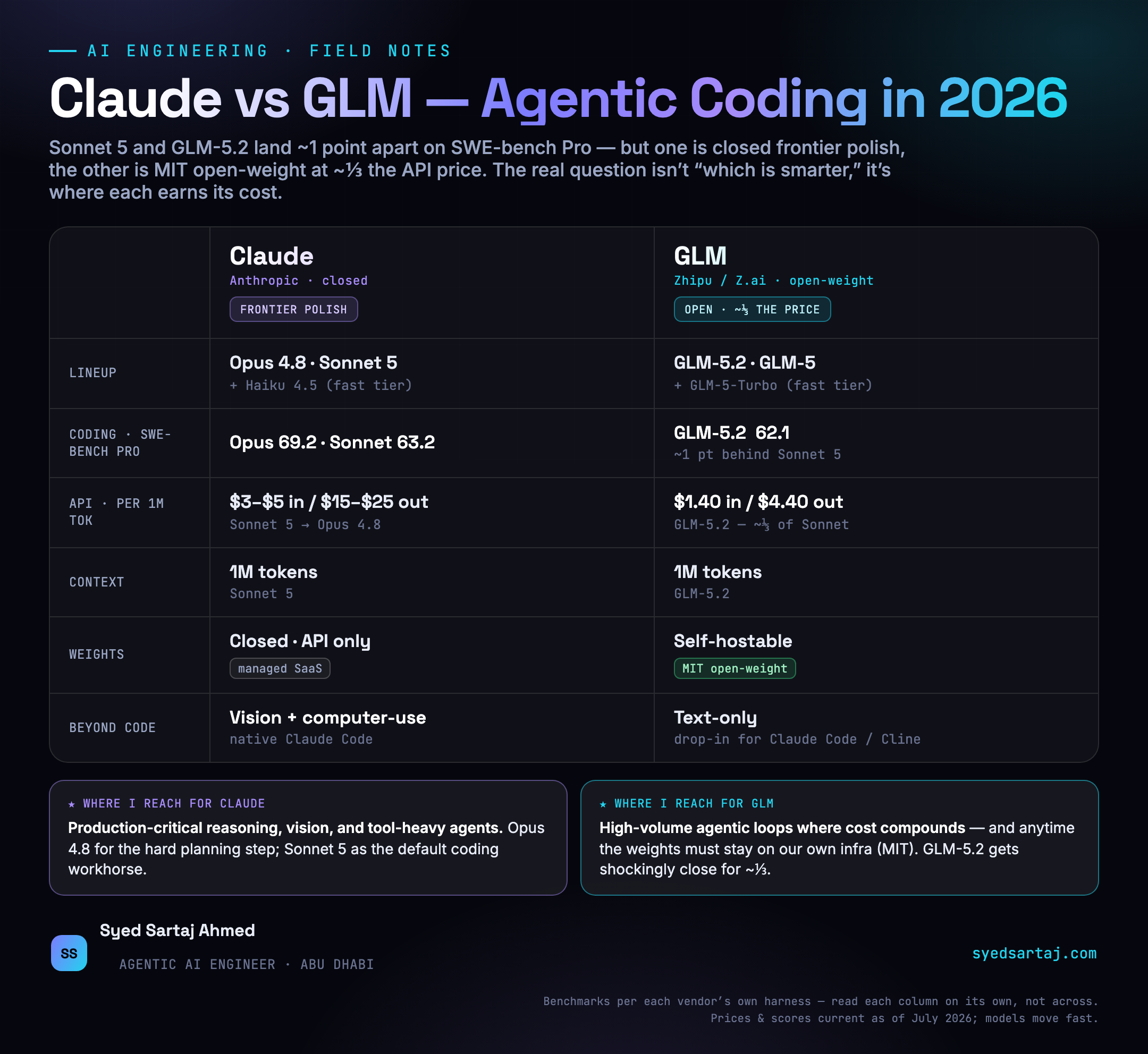
Short answer: for raw agentic coding, Anthropic’s Claude (Sonnet 5) and Zhipu’s GLM-5.2 land within about one point on SWE-bench Pro — but Claude is a closed frontier with vision and computer-use, while GLM is MIT open-weight at roughly a third of the API price. So the real 2026 question isn’t “which model is smarter,” it’s where each one earns its cost. Here’s how I split them in production.
The 2026 lineup at a glance
On the Claude side: Opus 4.8 is the reasoning flagship, Sonnet 5 is the coding workhorse (now with a 1M-token context), and Haiku 4.5 is the fast, cheap tier. On the GLM side, Zhipu (Z.ai) ships GLM-5.2 — a ~753B-parameter mixture-of-experts model with a 1M-token context, released June 2026 under the MIT license — alongside GLM-5 and the fast GLM-5-Turbo. The headline difference is philosophical: one is a polished managed API, the other is open weights you can download and run yourself.
Coding: closer than the price gap suggests
On SWE-bench Pro, Claude Sonnet 5 scores about 63.2 and GLM-5.2 about 62.1 — roughly one point apart. Claude Opus 4.8 sits clearly ahead at ~69.2 when you need maximum reasoning. The honest caveat: these numbers come from each vendor’s own harness, so read them as “same ballpark,” not a photo-finish ranking. The takeaway that matters for day-to-day work is that GLM-5.2 is genuinely in the frontier conversation for coding, not a budget also-ran.
Price: where GLM makes its case
This is the gap that doesn’t close. GLM-5.2 is roughly $1.40 in / $4.40 out per million tokens, versus Sonnet 5 at $3 / $15 and Opus 4.8 at $5 / $25. That’s about a third of Sonnet’s API price for output. Zhipu also sells a GLM Coding Plan (subscription tiers starting around $18/month, with intro promos lower) that plugs straight into agentic coding tools. When your workload is a tight agent loop firing thousands of calls, that difference stops being a rounding error and starts being your infrastructure budget.
Open-weight vs closed: the strategic difference
GLM-5.2 is MIT-licensed and self-hostable — you can run the weights on your own GPUs, fine-tune them, and keep every token on your own infrastructure. Claude is closed and API-only, which is what makes its polish, safety tuning, vision, and computer-use possible. For a lot of teams in the UAE and wider GCC I work with, that self-hosting option isn’t about saving money — it’s about data residency: sensitive code and customer data that legally can’t leave the country. Open weights turn “we can’t use an LLM here’ into “we host it ourselves.”
Can you run GLM inside Claude Code?
Yes — and that’s a big part of GLM’s momentum. Because the tooling ecosystem standardised around an Anthropic-compatible endpoint, GLM models drop into Claude Code, Cline, and similar agentic coders as a swappable backend. In practice that means you can keep your entire workflow and just point it at a cheaper or self-hosted model for the high-volume grunt work. The tooling and the model are no longer locked together.
How I actually split them in production
I don’t treat this as “pick one.” I route by job:
- Claude (Opus 4.8 / Sonnet 5) — the hard planning and architecture step, anything needing vision or computer-use, and production-critical reasoning where a subtle mistake is expensive. Sonnet 5 is my default interactive coding driver.
- GLM-5.2 — high-volume agentic loops where cost compounds (batch refactors, test generation, large-scale doc parsing), and any project where the weights must stay on our own infra for data residency. It gets shockingly close to Sonnet for roughly a third of the price.
The frontier model earns its premium on the 10% of work that’s genuinely hard; the open-weight model earns its place on the 90% that’s high-volume and cost-sensitive.
The caveats worth stating out loud
GLM-5.2 is text-only — no vision, no computer-use — so it can’t cover the multimodal agent work Claude can. Benchmarks are per-vendor and move every quarter. And prices are promotional and change fast: Anthropic, for example, was running an intro rate on Sonnet 5 through August 2026. Treat every number here as a July-2026 snapshot, and re-check before you standardise on anything.
FAQ
Is GLM better than Claude for coding?
On SWE-bench Pro they’re within about a point (Sonnet 5 ~63.2 vs GLM-5.2 ~62.1), with Claude Opus 4.8 ahead at ~69.2 for the hardest reasoning. GLM isn’t “better” overall — it’s comparable on coding at roughly a third of the price, while Claude leads on reasoning, vision, and polish.
How much cheaper is GLM than Claude?
GLM-5.2 API pricing is about $1.40 in / $4.40 out per million tokens versus Sonnet 5’s $3 / $15 — roughly a third of the output cost — and you can self-host the MIT weights to push marginal cost lower still.
Can I use GLM models in Claude Code?
Yes. GLM-5.2 and GLM-5-Turbo work as a drop-in backend for Claude Code, Cline, and similar tools via an Anthropic-compatible endpoint, so you keep your workflow and swap only the model.
Is GLM-5.2 really open source?
The weights are released under the MIT license and are self-hostable, so you can run and fine-tune them yourself. It’s open-weight in the practical sense that matters for data residency — though, like most large models, it’s text-only and huge to host.
Which should I choose in 2026?
Choose Claude when reasoning depth, vision/computer-use, or polish are the priority; choose GLM when cost compounds across high-volume agent loops or the weights must stay on your own infrastructure. Most serious teams end up using both, routed by job.
I build agentic AI systems in production and think about this routing decision every week. If you’re choosing a model stack or hiring engineers who obsess over it, let’s talk.
Tags: Claude, GLM, Agentic AI, LLM, Claude Code, AI coding, Anthropic, Open weight models