AI Agent Security 2026: The Lethal Trifecta, Explained
AI & ML
By Syed Sartaj Ahmed · 7/27/2026 · 10 min read
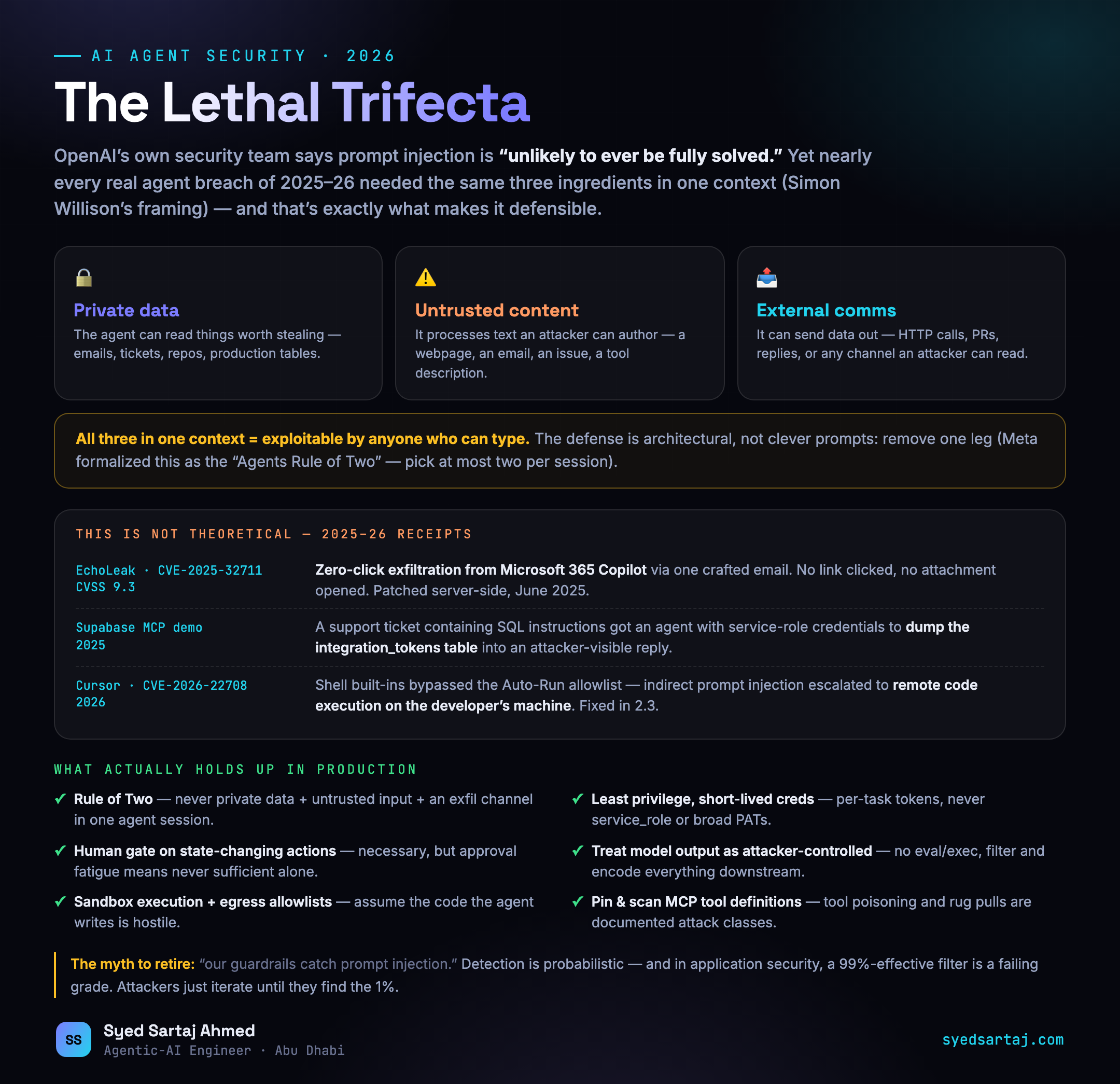
AI agent security in 2026 comes down to one pattern. Nearly every real agent breach of the past two years — the Microsoft 365 Copilot zero-click, the Supabase database dump, the Cursor remote-code-execution chain — required the same three ingredients in one context: access to private data, exposure to untrusted content, and a way to communicate externally. Simon Willison named it the lethal trifecta, and it's the most useful mental model in the field, because the defense follows directly: remove one leg. Here is the current threat landscape, the receipts, and the defenses that actually survive production.
Prompt injection is unsolved — officially
This isn't a doomer take; it's the vendors' own position. OpenAI's CISO called prompt injection "a frontier, unsolved security problem," and OpenAI's December 2025 advisory says it's "unlikely to ever be fully solved." The UK's NCSC agrees. The reason is structural: an LLM cannot reliably distinguish instructions from data within its context, and detection-based defenses are probabilistic. As Willison puts it — in application security, a 99%-effective filter is a failing grade; attackers iterate until they find the 1%.
The lethal trifecta (and Meta's Rule of Two)
An agent is exploitable-by-design when one session combines:
- Private data — it can read things worth stealing (emails, tickets, repos, production tables);
- Untrusted content — it processes text an attacker can author (a webpage, an email, an issue, a tool description);
- External communication — it can send data out (HTTP, PRs, replies — any channel an attacker can read).
All three together mean anyone who can type at your agent can, eventually, exfiltrate through it. Meta formalized the defense as the "Agents Rule of Two": an agent session should satisfy at most two of the three. That's an architecture decision, not a prompt.
The receipts (2025–26)
- EchoLeak — CVE-2025-32711, CVSS 9.3. Zero-click exfiltration from Microsoft 365 Copilot via a single crafted email. No link clicked, no attachment opened. Patched server-side June 2025 — but the vulnerability class remains open everywhere.
- GitHub MCP exploit (Invariant Labs). A malicious public issue steered an agent into leaking private-repo contents into a public PR.
- Supabase MCP demo. A support ticket containing SQL instructions got a Cursor agent running with service-role credentials to dump the
integration_tokenstable into an attacker-visible reply. Textbook trifecta. - 2026, frameworks themselves: Microsoft Semantic Kernel RCEs (CVE-2026-26030, CVE-2026-25592 — prompt injection escalating to host code execution; patched), and Cursor CVE-2026-22708: shell built-ins bypassed the Auto-Run allowlist, turning indirect prompt injection into RCE on the developer's machine (fixed in 2.3).
MCP's specific attack classes
Because agents ingest tool descriptions from third-party servers, MCP added new vectors, first documented by Invariant Labs: tool poisoning (malicious instructions in tool metadata — a tool never even called still influences the agent), rug pulls (a server swaps a vetted tool definition after approval — now CVE-2025-54136), and cross-server shadowing (one server's descriptions bending a trusted server's tool use). Mitigations: pin and hash tool definitions, scan them (open-source mcp-scan), prefer read-only modes — while remembering read-only removes only one trifecta leg; data can still leak through response text.
OWASP caught up: the Agentic Top 10
The OWASP LLM Top 10 (2025) still leads with prompt injection, but agent-specific risks now have their own list — the OWASP Top 10 for Agentic Applications (December 2025): goal hijack, tool misuse, identity & privilege abuse, agentic supply chain, unexpected code execution, memory poisoning, insecure inter-agent comms, cascading failures, human-agent trust exploitation, rogue agents. If you're threat-modeling an agent product in 2026, that's the checklist to map against — and mid-2026 reporting confirms prompt injection still drives most production agentic failures.
What actually holds up
- Rule of Two — never all three trifecta legs in one session; split workflows so the untrusted-content processor can't also exfiltrate.
- Least privilege, short-lived credentials — per-task tokens; never service_role keys or broad PATs in an agent's hands.
- Human gates on state-changing actions — necessary but not sufficient: approval fatigue is real, so gates guard the blast radius, not the front door.
- Treat model output as attacker-controlled — no eval/exec on it, encode and filter it downstream.
- Sandbox code execution with egress allowlists — assume agent-written code is hostile until proven otherwise.
- Pin & scan MCP tool definitions — poisoning and rug pulls are documented, CVE-carrying attack classes.
On the research frontier, DeepMind's CaMeL is the most credible design: a privileged LLM plans control flow while a quarantined LLM touches untrusted data with no tool access, with capability metadata flowing through values — 77% of AgentDojo tasks completed with provable security. It's the dual-LLM pattern grown up, and the direction serious agent platforms are heading.
What doesn't work
"Our guardrails catch prompt injection" — probabilistically, sometimes. As the sole defense, that's the 99%-is-failing problem. Same for human-in-the-loop alone (fatigue), output filters alone (encoding games), and "we only use read-only tools" (response text is an exfil channel). Defense in depth isn't a buzzword here; it's the only thing left after you accept the model itself can be socially engineered.
FAQ
What is the lethal trifecta in AI security?
Simon Willison's term (June 2025) for the combination that makes an agent exploitable via prompt injection: private-data access + untrusted content + an external communication channel. Remove one leg and the worst outcome shrinks from breach to nuisance.
Can prompt injection be fixed with better prompts or filters?
No. Vendors themselves (OpenAI, NCSC) state it may never be fully solved. Filters reduce frequency; architecture (Rule of Two, least privilege, sandboxing) bounds impact.
Are MCP servers safe to use?
Treat each one like a dependency with access to your data: audit it, pin its tool definitions, scope its credentials to least privilege, and gate its state-changing actions. The protocol's auth has matured; the trust decision about each server is still yours.
Is prompt injection the same as jailbreaking?
No. Jailbreaking attacks the model's own safety rules; prompt injection smuggles attacker instructions into a trusted context via data the agent processes. Agents mostly get breached by the latter.
Shipping an agent and want a security review against the Agentic Top 10? Get in touch. Related: MCP explained and why AI agents fail in production.
Tags: AI Security, Prompt Injection, AI Agents, MCP, OWASP