AI Agent Frameworks 2026: LangGraph vs OpenAI SDK vs MAF
AI & ML
By Syed Sartaj Ahmed · 7/22/2026 · 10 min read
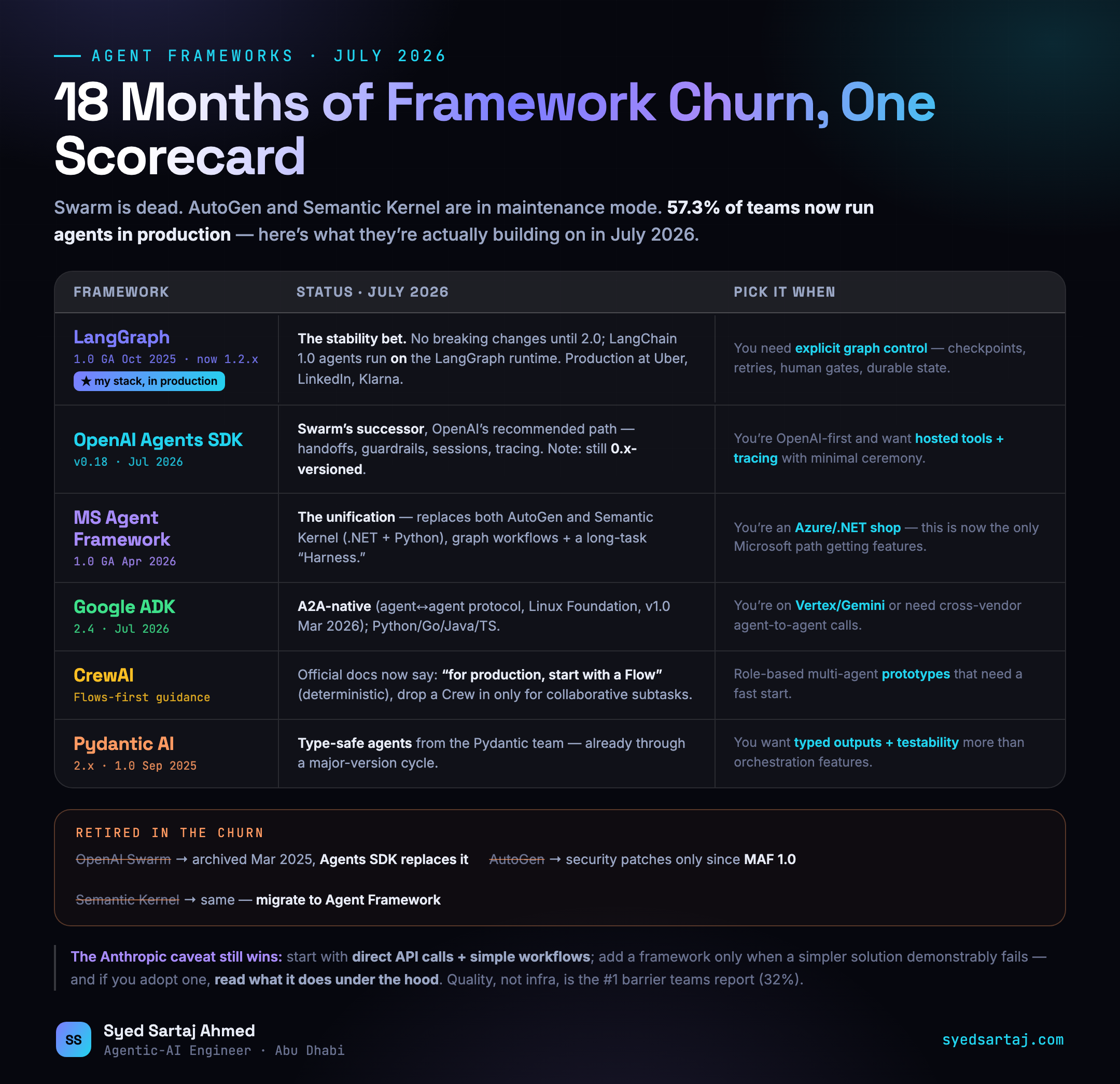
Which AI agent framework should you use in 2026? Short version: LangGraph if you need explicit control and durable state (it's what I run in production), OpenAI Agents SDK if you're OpenAI-first, Microsoft Agent Framework if you're an Azure/.NET shop, Google ADK on Vertex — and possibly no framework at all, which remains Anthropic's standing advice. The last 18 months killed or froze three major frameworks, so the real skill isn't picking the hottest one; it's not betting on the wrong horse. Here's the scorecard, with what died and why.
First, what died
- OpenAI Swarm — archived March 2025; its README literally says the Agents SDK replaces it. People still recommend it in forums.
- AutoGen and Semantic Kernel — both in maintenance mode (security patches only) since Microsoft Agent Framework 1.0 went GA in April 2026. New features land only in MAF, and Microsoft published official migration guides. "Use AutoGen for multi-agent" is now outdated advice.
That's three majors retired inside 18 months. Framework churn is the tax of this ecosystem — factor it into any adoption decision.
The scorecard (July 2026)
- LangGraph — the stability bet (my stack). 1.0 went GA in October 2025 with a no-breaking-changes-until-2.0 commitment; now on 1.2.x. LangChain 1.0 agents run on the LangGraph runtime, so the old "LangChain vs LangGraph" choice is gone. Production users include Uber, LinkedIn and Klarna. Pick it when you need explicit graph control: checkpoints, retries, human approval gates, durable state.
- OpenAI Agents SDK — the default for OpenAI-first teams. Swarm's successor: agents, handoffs, guardrails, sessions, tracing, hosted tools. Actively shipped (v0.18, July 2026) — but note it's still 0.x-versioned despite being OpenAI's recommended production path.
- Microsoft Agent Framework — the unification. 1.0 GA April 2026, .NET + Python, absorbing AutoGen's multi-agent patterns and Semantic Kernel's enterprise plumbing, plus graph workflows and a long-task "Harness." If you're on Azure this is now the only Microsoft path getting features.
- Google ADK — the A2A play. v2.4 (July 2026), four languages, native Agent2Agent support. A2A itself is Linux Foundation-governed, hit spec v1.0 in March 2026, with 150+ member orgs — it's the agent↔agent complement to MCP's agent↔tools.
- CrewAI — read their own docs carefully. The official guidance now says: "for any production-ready application, start with a Flow" (deterministic), and drop a Crew in only for collaborative subtasks. That's the vendor telling you role-played autonomous crews aren't the production pattern.
- Pydantic AI — the type-safety pick. 1.0 in September 2025, already at 2.x. If your priority is typed outputs and testability over orchestration features, it's excellent.
- smolagents — the code-first curiosity. Hugging Face's take: the agent writes and executes Python instead of emitting JSON tool calls. Actively maintained; great for research-flavored work.
What teams actually run
LangChain's State of Agent Engineering survey (1,340 respondents, fielded late 2025): 57.3% have agents in production, 67% at 10k+-employee orgs; the #1 barrier is quality (32%), not infrastructure; and 89% run observability while only ~52% run systematic evals. Caveat it honestly — it's a LangChain-audience sample. And the "Gartner says 61%" framework-share stats circulating on SEO farms have no traceable primary source; don't repeat them.
The Anthropic caveat that keeps aging well
"Building Effective Agents" (Dec 2024) remains the best-calibrated advice in the space: workflows (predefined code paths) beat agents (LLM-directed control flow) for most tasks; start with direct API calls; add complexity only when a simpler solution demonstrably fails; and if you do adopt a framework, read what it generates under the hood. Note the nuance people miss: Anthropic isn't anti-framework — they ship the Claude Agent SDK — the advice is against premature abstraction.
Why I still choose LangGraph
My agents run long, multi-step jobs against Postgres-backed state. LangGraph's checkpointing (PostgresSaver), resumability and human-gate primitives map exactly onto that: every step is a node, every pause is a checkpoint, every approval is an interrupt. When something fails at 2am, I can replay the exact graph state that produced it. That operational story — not the API sugar — is what a framework has to earn its abstraction tax with.
FAQ
What is the best AI agent framework in 2026?
There isn't one — there's a best fit per ecosystem: LangGraph for control and durability, OpenAI Agents SDK for OpenAI-first stacks, Microsoft Agent Framework on Azure, Google ADK on Vertex. And for many products, plain API calls in a workflow beat all of them.
Is LangGraph production-ready?
Yes — 1.0 GA (Oct 2025) with API stability guaranteed until 2.0, running in production at Uber, LinkedIn and Klarna, and in my own systems.
Is AutoGen deprecated?
Effectively: it receives security patches only. New development happens in Microsoft Agent Framework, and Microsoft provides migration guides from both AutoGen and Semantic Kernel.
Do I need an agent framework at all?
Often not. If your task decomposes into a known sequence, a workflow of direct API calls is simpler, cheaper and easier to debug. Reach for a framework when you genuinely need durable state, checkpointing, human gates or multi-agent handoffs.
Choosing (or escaping) an agent framework? Get in touch. Related: why AI agents fail in production, agent memory on Postgres and MCP explained.
Tags: AI Agents, LangGraph, Agent Frameworks, Agentic AI, LLM